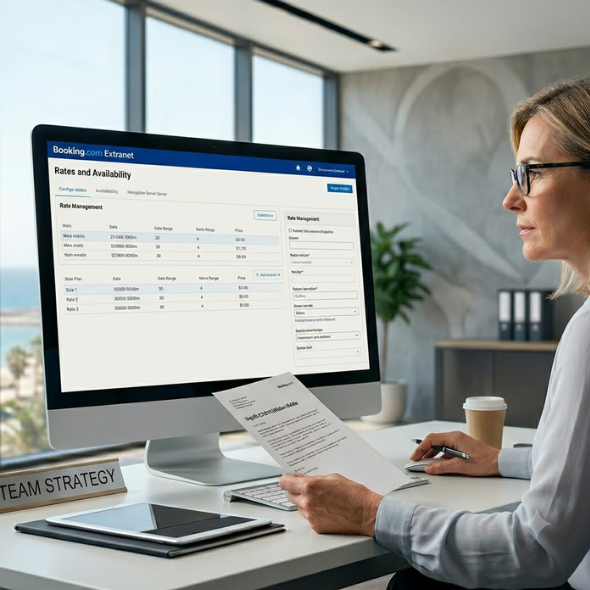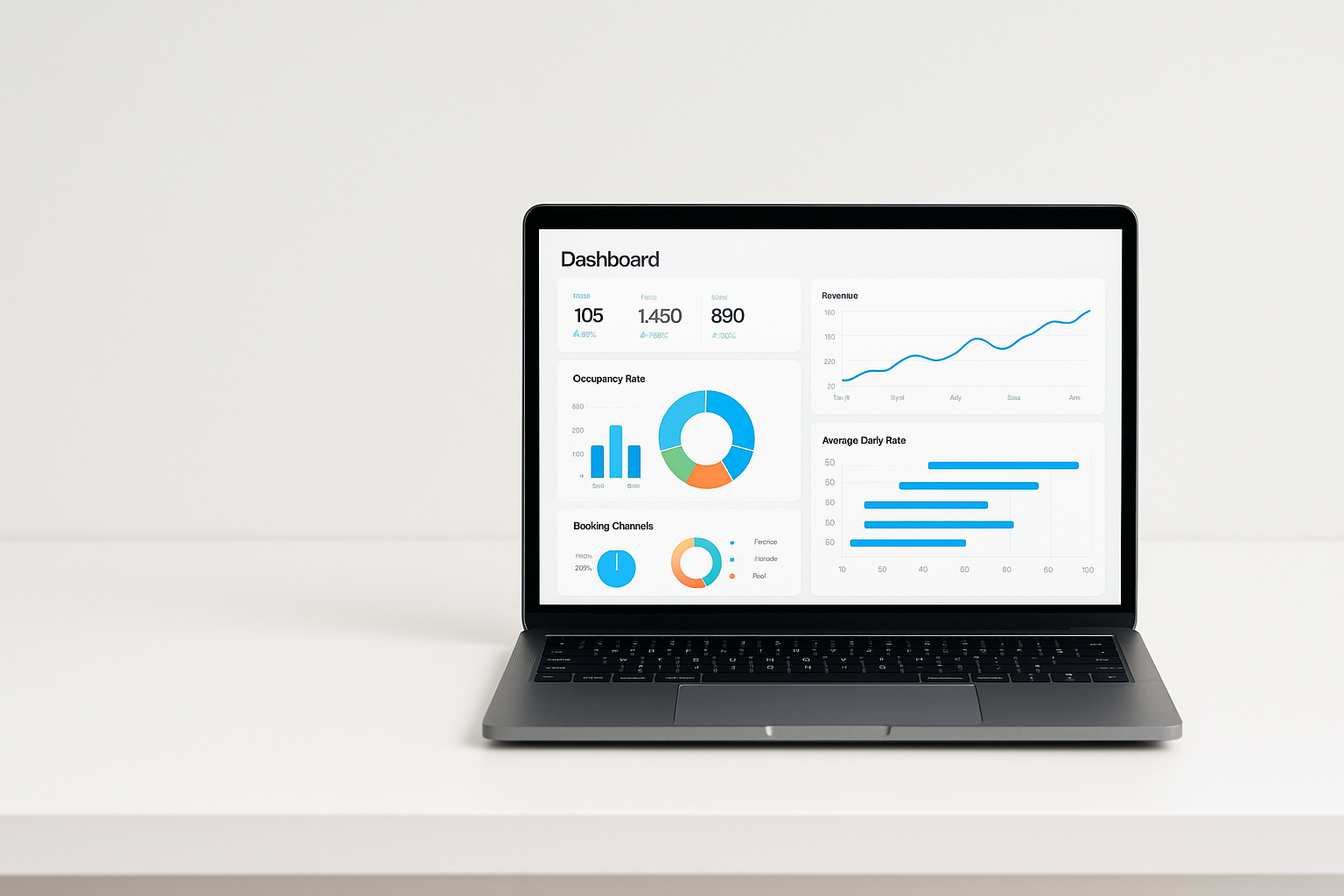
Data flows continuously through your systems: bookings, competitor pricing, channel pickups, room statuses, guest requests. In this article, we look at how real-time changes prices, occupancy, and services, with concrete examples, operational metrics, and a look at the platforms that make it possible.
The hotel industry in 2025 is stable but highly competitive: in the United States, average occupancy is forecast at 63,38% (almost at 2019 levels), while in April 2025, occupancy was 63,9% with an ADR of $161,28 . Over the summer, forecasts were revised downward, and some chains adjusted their revenue guidance. In such a "flat" scenario, the ability to read and act on data in real time makes all the difference. This is where a PMS integrated with BI and revenue tools becomes the nerve center of daily decisions.
Dynamic prices that react to the market (not the next day)
Topics index
If pickup speeds up at 10:30, waiting for the afternoon report means losing money. Modern revenue management systems (RMS) consume continuous flows: future market demand, real-time rate comparisons, channel trends, cancellations, and no-shows. The logic is simple: right price, on the right channel, at the right time.
Why invest in it today? Independent analyses indicate that hotels adopting an RMS often see a 15-20% increase in RevPAR compared to properties without similar automation. This isn't "magical": it comes from continuous micro-adjustments that a team couldn't make manually across hundreds of dates and segments. Furthermore, intelligence providers like Amadeus have introduced AI enhancements to Demand360 in 2025 to sharpen insights and speed response: this means fresher and more granular demand windows, useful when booking curves are shortening.
A moderate growth environment and pressured margins are pushing a shift from static forecasting to a faster "read-decide-apply" cycle: Duetto, for example, talks about flattening revenue growth in 2025, which makes tactical execution based on market signals, not historical averages, critical. In practice, this means adjusting occupancy thresholds, LOS constraints, and add-on supplements on a daily basis , not weekly.
Operational takeaway: connect “smart” rates to your booking engine and main channels, set safeguard rules (price fences, min/max limits per segment) and check three real-time KPIs every morning: pickup by channel, competitor price variations, price/positioning vs. forecasted demand.
Operations and housekeeping: when "room clean" unlocks check-in
Real time isn't just about the rate: it impacts the operational promise . A room marked "clean" in the PMS must immediately trigger a chain of events: smart assignment, availability message to the guest, upsell (e.g., early check-in at a dynamic rate), and digital key. By 2025, many hotels have shifted automation from rigid calendars to behavioral triggers: systems send messages when an event occurs, for example, an immediate welcome when the room status changes to "ready."
This directly impacts costs and satisfaction: housekeeping, maintenance, and supply credits enter a prioritized queue based on actual, not theoretical, arrival. AI hospitality tools also support staff assignment to shifts and floors, reducing dead time (empty floors, unnecessary travel) and anticipating recurring requests (extra pillows, cribs, allergies).
Practical metrics to follow every day:
- Medium room turnaround.
- Response time to in-stay requests (from ticket opening to ticket closure).
- Early check-in rate by date/segment (and related revenue).
When these three indicators flow in real time on the management dashboard, you can reallocate teams and priorities on the same day , avoiding cascading delays at peak arrivals.
In a modern architecture, the PMS is the linchpin: it aggregates availability, rates, guest profiles, room status, and revenue; it exposes this data via API to RMS, BI, and messaging. Some solutions, like Mews , focus precisely on automation, connectors, and real-time updates to reduce the time between events and action. The goal isn't to "sell technology," but to have up-to-date information where it's needed: at the front desk, in the rooms department, in revenue, and in marketing. (If you prefer a "best-of-breed" approach, the principle remains the same: no silos, minimal synchronization times, and event-based logic.)
Experience and upselling: the right window is now (not in 24 hours)
Today's guests expect quick, contextual interactions. Research published in 2025 shows that 70% of guests find chatbots useful for simple requests; at the same time, the use of guest apps and messaging for instant responses and in-stay recommendations is growing. In other words: if your breakfast offer arrives after the guest has already checked out, it's noise; if it arrives immediately after check-in (or when the PMS detects they haven't purchased breakfast), it's value.
Behavioral messaging has this advantage: it doesn't bombard, but rather addresses strong signals (arrival, room status, geolocation within the property, failure to purchase an add-on). In 2025, best practices suggest event -driven messaging rather than time-based messaging. And here, the role of the PMS as an "orchestrator" returns: operational status (cleaning, maintenance, charges) fuels the customer engagement engine in real time.
Want a concrete example? Many brands connect the PMS-messaging flow to dynamic keys : if the guest unlocks the door after 19:00 PM on the first night, the algorithm offers a late checkout at a personalized rate; if it's the second night and they don't have breakfast, it offers a breakfast + late checkout bundle. Here, market BI tools help calibrate the price threshold, using future demand from the destination market and pick-up from your comp-set.
Practical tip: Integrate messaging with your direct channels and measure the upsell attach rate by segment (solo, couples, families, businesses). If the attach rate increases when you send within 15 minutes of check-in, you've found your window.
KPIs and data-driven culture: what to look for today
“Real time” only makes sense if tied to clear objectives . A useful set of KPIs in 2025, to be read on the same dashboard (and on the GM's smartphone), is this:
- Pickup by channel and segment (rolling 24/48h) with alerts on deviations > X% vs forecast.
- Tariff positioning vs comp-set, with guardrail rules (min/max per segment).
- Expected occupancy of the next 14 days, updated live by booking/cancellation signals.
- Cost of acquisition by channel (including temporary incentives and OTA promos).
- Turnaround housekeeping e response time front office/maintenance.
- In-stay NPS/CSAT collected via messaging, not just post-stay.
For external comparison and planning, the industry continues to use STR benchmarks (occupancy, ADR, RevPAR), with weekly releases and updated forecasts. In April 2025, for example, STR reported ADR +1,8% against stable RevPAR, a sign of elastic demand and greater price sensitivity. This makes dynamic rate micro-positioning even more important.