

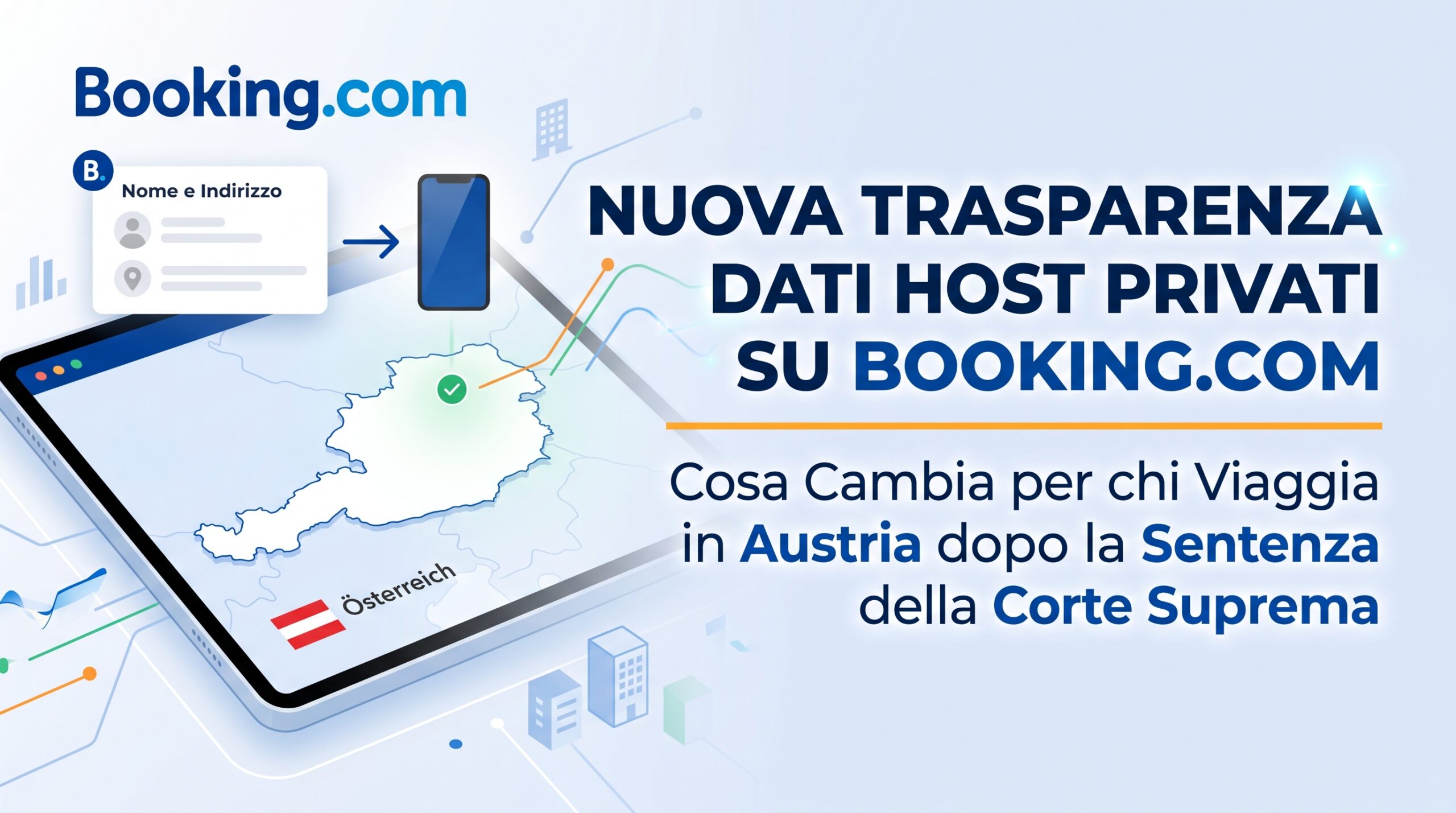
Booking.com and Privacy: Private Host Data Visible to Travellers Residing in Austria Booking.com has updated its automated systems following the Austrian Supreme Court ruling ( case no. 4 Ob 28/26k ).
From now on, travelers residing in Austria will receive the private host's full name and address via email immediately after booking confirmation. This update only applies to private hosts worldwide who receive bookings from Austrian residents. Partners do not need to take any manual action.
A new piece has been added to the issue of transparency and regulation of short-term rentals in Europe. Following a binding decision by the Austrian Supreme Court (ruling no. 4 Ob 28/26k) , the OTA platform Booking.com has introduced a substantial change to the way it sends booking confirmations to travelers residing in Austria.
If you manage a property or vacation rental as a private host on the platform, here's everything you need to know about how sharing your personal data has changed.
What does the Austrian Supreme Court ruling 4 Ob 28/26k provide?
Topics index
The court ruling requires Booking.com to ensure immediate transparency regarding the personal details of private landlords.
Unlike previously, the name and actual address of the private accommodation provider will be forwarded to Austrian tourists immediately after completing the booking . These details will be integrated directly into the traditional booking confirmation email.
Which properties and hosts are involved?
The impact of this measure varies based on two key parameters: the host type declared on the Extranet and the traveler's residence.
| Host Type | Traveler's residence | Are the data (Name and Address) sent in the confirmation email? |
| Private Host (Private / Non-professional) | Austria | YUP (Immediately after booking) |
| Private Host (Private / Non-professional) | All other countries | DO NOT (They remain confidential according to normal standards) |
| Professional Host (Company / VAT number) | Any Country | DO NOT (Information already publicly visible on the card) |
How is the personal data of hosts handled?
Many private partners have expressed concerns about their privacy. Booking.com has clarified the following key points:
No public publication: The private host's personal information (name, surname, and residential/declared address) is not visible on the public web portal nor accessible to users browsing the platform without booking.
Post-Booking Notification: This notification is only displayed on an ad hoc basis for Austrian travellers who have completed a confirmed booking.
Global Reach for Hosts: The measure applies to all private hosts worldwide (Italian, Spanish, French, etc.) when they receive a stay from an Austrian citizen/resident.
What should partner accommodation facilities do?
Booking.com's systems have already been automatically updated to comply with the regulation. Partners who have registered their properties as private hosts do not need to change settings or upload additional documents.
This update is part of the broader self-declaration framework required by the European Union's Digital Services Act (DSA) . While Professional Hosts have long displayed their company details and VAT numbers directly on their property's public page, the process for Private Hosts remains different.
In fact, the information provided during contractual registration will continue to remain private for the majority of the public, with the sole exception of cases where the end customer is a traveler residing in Austria.
The measure concerns Booking.com's automatic compliance with Austrian transparency rulings (Case 4 Ob 28/26k). The data forwarded includes the name and address of the private host, transmitted directly via the confirmation email sent to the customer.
Viewing this information is reserved exclusively for travelers residing in Austria, so no manual action is required by partners.
Operational considerations for managing short-term rentals
For those who manage tourist properties or B&Bs on a non-commercial basis, it is crucial to always keep your self-declaration of host status updated within the Booking.com Partner Hub. Verifying that the address specified in the platform agreement corresponds to the correct one for tax and regulatory purposes will avoid discrepancies in automatic communications sent to international guests.
To learn more about the guidelines and check your classification on the platform, you can consult the official guide to the Digital Services Regulation requirements on the Booking.com Partner Hub.
Stay ahead of the curve in the tourism market! Stay up-to-date on upcoming regulatory updates, new market trends, practical guides on incentives, and funding opportunities for the hotel and non-hotel sector.


