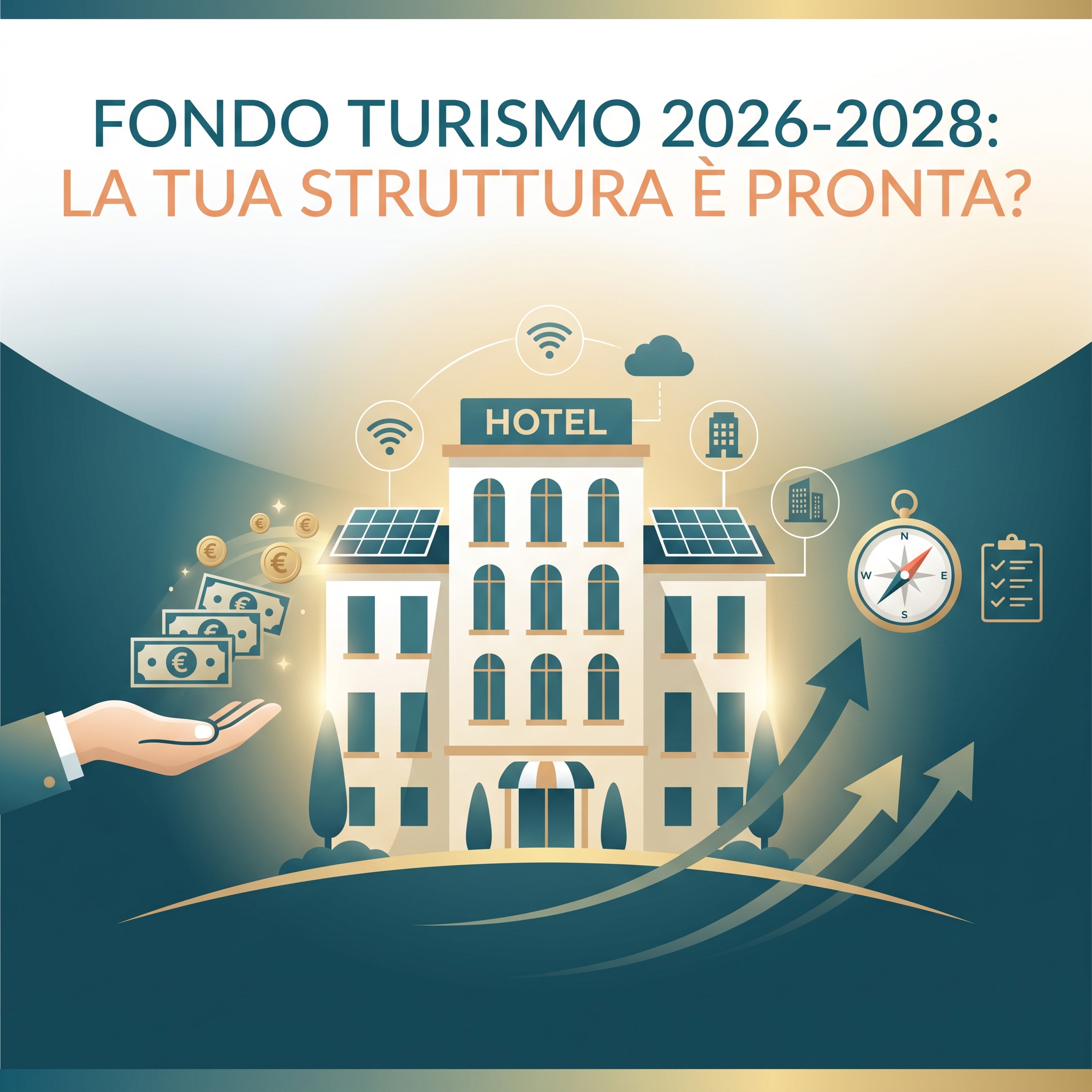
With the end of the summer season and the beginning of autumn, the crucial window opens for Italian hospitality businesses to plan investments for the three-year period 2026-2028. Following the allocation confirmed in the Budget Law—which allocated a total of €150 million (€50 million per year for 2026, 2027, and 2028) to the tourism sector—the sector is now awaiting the release of the Ministry of Tourism's Implementing Decrees, which will define the official opening dates for the service.
Moving in October is not just a strategic choice, but an operational necessity: preparing energy audits, bills of quantities, and digitalization projects requires several months of work. Waiting until the application deadline risks being excluded from non-repayable grants (which will cover up to 60% of eligible investments).
Summary of the measure
| Voice | Facilitation details |
| Normative reference | Budget Law (Art. 1, paragraphs 469-470, Law 199/2025) |
| Overall equipment | €150 million (€50 million/year for the years 2026, 2027 and 2028) |
| Intensity of aid | Non-repayable grant of up to 60% of eligible investments |
| Beneficiaries | Hotels, B&Bs, Resorts, Agritourism and Non-Receptive Facilities |
| Pillars of intervention | Digital Innovation, Deseasonalization, ESG Standard Adjustment |
The 3 fundable pillars: Innovation, seasonal adjustment and ESG
Topics index
The resources allocated by the Structural Fund aim to increase the overall competitiveness of Italy as a destination on the global market through three main lines:
Technological innovation and digitalization: Adoption of advanced management software (next-generation PMS), automated self-check-in systems, integration of AI-based tools for revenue management and optimization of the guest experience.
Deseasonalization of the offer: Creation of multipurpose spaces, adaptation of facilities for business tourism (MICE), construction of wellness centers, heated swimming pools, covered outdoor areas, and experiential services active year-round to attract tourist flows during the low season months.
Compliance with ESG (Environmental, Social, Governance) Standards: Building energy efficiency improvements, installation of renewable energy systems (photovoltaic, solar thermal, heat pumps), reduction of water waste, environmental certifications (e.g., ISO 14001, LEED, GSTC), and elimination of architectural barriers.
ESG Focus: Compliance with ESG criteria is not just an incentivized expense item, but also an essential lever for accessing bank credit and attracting sustainability-conscious international demand.
Detail of incentives and investment cuts
The call for proposals offers particularly advantageous conditions, particularly for the window dedicated to medium-sized projects, with a non-repayable grant covering up to 60% of the total cost of the admitted works.
| Project window | Contribution Measure | Type of Eligible Expenses |
| Piccola dimensione | Non-repayable grant from 40% to 50% | Digitalization, PMS software, minor efficiency improvements, home automation. |
| Medium size | Non-repayable grant up to 60% | Energy requalification, seasonal adjustment structures, ESG certifications, advanced home automation. |
| Big projects | Mix of Non-Repayable Funds + Subsidized Financing | Complex building renovations, structural extensions, carbon neutrality of the property. |
Roadmap: How to prepare for your application
In anticipation of the opening of ministerial platforms, subsidized finance experts advise accommodation facilities to take early action by following these steps:
Requirements Audit: Identify priority technical, digital, or structural interventions and verify compliance with eligible criteria.
ESG and technological feasibility study: Develop energy diagnoses and digital transition plans signed by qualified technicians.
Estimates and cost estimates: Collect detailed cost estimates from stakeholders in the IT and construction supply chain.
Guide to applying for the Tourism Fund
For those who manage a hospitality facility and are unfamiliar with subsidized financing procedures, the application cannot be submitted via paper or simple email, but follows a specific digital process through the official Invitalia online platform (the national agency that manages the measure on behalf of the Ministry of Tourism ).
Here are the necessary technical steps and the tools your facility must equip itself with:
Before even accessing the platform, the legal representative of the structure (or the intermediary/delegated consultant) must have:
SPID or CIE: To authenticate on the Invitalia online platform.
Digital signature: Required to sign the application and all attached forms.
Certified email (PEC): Active and regularly registered in the Company Register for all official communications.
When the digital counter opens, the application is completed entirely online by uploading:
Company data and requirements: ATECO code authorized for the tourism and hospitality sector, valid DURC (Duration of Employment Benefits), and company financial statements for the last three years.
Technical documentation: Energy audit signed by a qualified technician (for ESG projects), digital transition plans (for PMS and software), and detailed bills of quantities with quotes provided by suppliers.
Possible award-winning qualifications: Environmental certifications (e.g., ISO 14001, GSTC), Legality Rating, or Gender Equality Certification, useful for climbing the merit rankings.
Applications are evaluated based on a ranking system with scores (not only the chronological order of submission, but also the quality of the proposed project). Once the project is approved, to facilitate the start of construction, eligible companies can request an advance of up to 30% of the non-repayable grant upon presentation of a bank or insurance guarantee.
💡Advice for operators: Given the complexity of the technical documentation required, the Ministry recommends seeking the support of qualified technicians (engineers/surveyors for the building-energy aspects) and consultants specializing in subsidized financing for the formal submission of the application.
To consult the text of the provision and the official implementing decrees, please refer to the institutional portal of the Ministry of Tourism.
Stay up to date on tourism incentives
Do you want to take advantage of all the subsidized financing opportunities and new tenders for your accommodation facility?
[Subscribe to the newsletter of Direzione Hotel] Get the latest news, market trends, insights into hotel bonuses, and practical tools to grow your hotel or non-hotel business.